
The Advance of Avant-garde
- May 18, 2020
- 6 min read
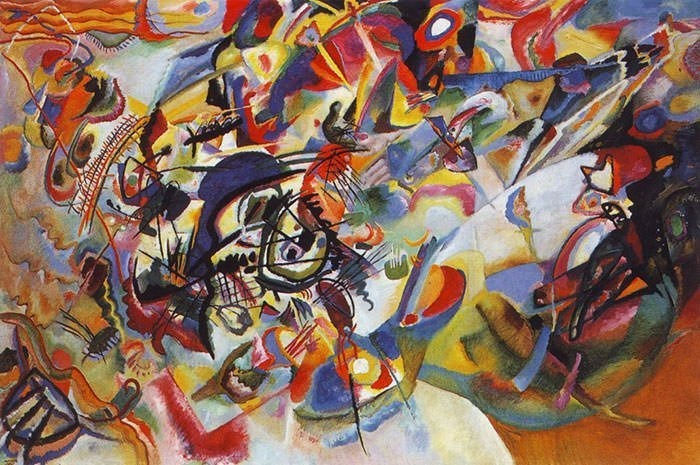
Through my studies of and about Kandinsky, Futurism and the flâneurs, I realized that a fundamental ideal figure of avant-gardism was evolving, veiled in various movements and landscapes of the times. At the end of the Industrial Revolution, the world was continually undergoing change. In France, a man named Haussman instigated a dramatic renovation of Paris under Napoleon III. Although the plan would make Paris an efficient city, citizens protested it would suck the sentiments from the streets. Heedless of the extreme opposition, the project went forward. Without Haussman’s renovation, we would not know the Paris of today. Literally, Paris gained electrical lights befitting her nickname: “The City of Lights.” Roaming Paris during this transformation were hip bourgeois called flâneurs. Flâneurs did not actually exist in any real sense. To be a flâneur was to fit characteristics of a physiological type of aspiration written about by essayists at the time. Sporting long coats, buttoned suits, and top hats, with cigars, umbrellas, and canes, these men were supposed to be cultured, detached, heroic figures. Before the renovation of Paris, they wondered about in boulevards, arcades, parks, restaurants, and cafes. Flowing seamlessly from private individual to public figure, a flâneur was a story-teller of the metropolis epic. “In the flâneur’s perceptive eyes, what appeared incoherent and meaningless gains focus and visibility. The flâneur brings alive and invests with significance the fleeting, everyday occurrences of the city that ordinary people failed to notice.” (Gluck, 69) With the virtue of the unobserved observer, the flâneur was the archetype of modernity, straddling the mean between dilettantism and over-specialization. Associated with genius skills in literature and art, “the unique relationship between the flâneur and the urban environment was invariably characterized by the metaphor of the city as text and the flâneur as reader. The image implied that the flaneur’s gift of imagination enabled him to treat the urban scene as an open book.” (Gluck, 71) Although French caricaturist Daumier poked fun at flâneurs, along with classical antiquity, flâneurs were intended to be reputable personalities. Along with the evolution of Paris, flâneurs evolved from the 1840s’ “popular” flâneurs to the 1850s’ “avant-garde” flâneurs . “His identify was based, not on typification, but on masks, disguises, and incognitos, through which he defined his empathic identification with modernity. At times, he was a child.” (Gluck, 77) No longer were flâneurs linked with physical occurrences, but transcended to eternal forms. With the city ostensibly zapped of emotion, flâneurs were called to peer into the essence behind the stark city and recover the aesthetic of Paris. “The city was no longer a labyrinth or a mystery, whose overall meaning would be revealed and decoded through the description of the urban observer. It had become the site of aesthetic experience and a particularly modern form of beauty, suddenly revealed through flashes of insight that were mediated through the creative vision of the artist.” (Gluck. 78). Although the flâneur may have lost his Paris playground, “he had become a truly cosmopolitan figure, gaining the ability to inhabit not simply the city, but the entire globe through his imagination.” (Gluck, 78) New experimental painters were emerging across Paris and the world, submitting their work to the official Paris Salon of the School of Fine Arts to be exhibited. Representing conservative academic taste and rejecting foreigners until after the French Revolution, The Salon was the most established and famous art show in Western Europe. Artists like Gericault pushed the standards of the Salon when he submitted Raft of the Medusa in 1819, which depicted the wreck of the French naval frigate Méduse. Besides depicting a profuse amount of dead corpses, the painting was seen as a criticism of the French captain who directed the sailing of the ship. While academic art by Jean-Jacques Dominique Ingres was accepted by The Salon, Manet’s “Le Dejeuner sur l’herbe” (Luncheon on the Grass) and “Olympia” were rejected. Sadly, Monet and all Impressionists were rejected from The Salon. Because rejects from The Salon reached record heights of three thousand in 1863, Napoleon III created the “Salon des Resfusés” (exhibition of rejects). Impressionists were criticized for painting “impressions”. Cubists were criticized for painting “cubes”. Despite rejections, Avant-garde continued to grow with Post-Impressionism (Seurat, Van Gogh and Cezanne), Fauvism (Matisse), Symbolism (Klimt) Expressionism (Munch and Kandinsky) Futurism (Boccioni), and “analytical” and “synthetic” Cubism (Picasso and Braque). In 1913, Alfred Stieglitz picked up The Salon’s slack in New York City with his famous art gallery. At this gallery, Margaret Naumburg, the “Mother of Art Therapy”, was influenced by primitivism and Matisse, Braque, and Picasso art, later developing “Dynamically Oriented Art Therapy” which is deeply entrenched in symbology and Jungian and Freudian psychoanalysis. “Every work of art is the child of its age and, in many cases, the mother of our emotions.” (Kandinsky, 9) Kandinsky believed art was a spiritual endeavor. According to him, ideal art stimulated emotions in the soul. In “Concerning the Spiritual in Art” he claimed that the “spark of inner life” was struggling in the materialistic world: “Only a feeble light glimmers like a tiny star in a vast gulf of darkness. This feeble light is but a presentiment, and the soul, when it sees it, trembles in doubt whether the light is not a dream, and the gulf of darkness reality.” (Kandinsky, 9) Hostile to representation in art, he denounced the imitation of classical styles in modern work: “Such imitation is mere aping. Externally the monkey completely resembles a human being; he will sit holding a book in front of his nose, and turn over the pages with a thoughtful aspect, but his actions have for him no real meaning.” (Kandinsky, 9) Developing a metaphysical triangle system with an avant-garde artist figure at the peak which resembled a combination of Nietzsche’s Übermensch (Superman) and Sisyphus, he wrote: “there never fails to come to the rescue some human being, like ourselves in everything except that he has in him a secret power of vision. He sees and points the way. The power to do this he would sometimes fain lay aside, for it is a bitter cross to bear. But he cannot do so. Scorned and hated, he drags after him over the stones the heavy chariot of a divided humanity, ever forwards and upwards.” (Kandinsky, 12) Within the theory, there are periods of depravity in which individuals must feed on spiritual sustenance in lower segments and be dragged downward and off the triangle. In efforts to improve the situation, he developed principles of art and color theory, likening art to music: “Repetition of the same appeal thickens the spiritual atmosphere which is necessary for the maturing of the finest feelings, in the same way as the hot air of a greenhouse is necessary for the ripening of certain fruit.” (Kandinsky, 43) Inevitably, artists envy the ease with which musicians can evoke emotion. In a quest for the integration of all art forms, he dreamed the future of theatre would contain musical, pictorial, and physical movement. Criticizing Picasso for focusing on form and neglecting color, he believed art should affect all the five senses of sight, smell, hearing, taste, and touch. Writing in 1911, Kandinsky was an early advocate for avant-garde along with Der Balue Reiter (The Blue Rider) group. In 1909, hypothetical futurists hollered in their manifesto: “Here and there unhappy lamps in the windows taught us to despise our mathematical eyes. `Smell,' I exclaimed, `smell is good enough for wild beasts!'” (Marinetti, 1) “`Let us leave good sense behind like a hideous husk and let us hurl ourselves, like fruit spiced with pride, into the immense mouth and breast of the world! Let us feed the unknown, not from despair, but simply to enrich the unfathomable reservoirs of the Absurd!'” (Marinetti, 2) The idea of the capitalized “Absurd” is made famous by Albert Camus in his writings and novels (The Myth of Sisyphus, The Stranger, and The Plague) The Plague is especially relatable in regards to the COVID-19 of today. “What’s true of all the evils in the world is true of plague as well. It helps men to rise above themselves.” (Camus) Like Kandinsky, but unlike the Parisians, the Futurists greet progress in a manner more aggressive than either. “Standing on the world's summit we launch once again our insolent challenge to the stars!” (Marinetti, 4) What a mouthful! What do the Dadaists have in store? (hopefully toilet paper) “I tell you: one must still have chaos in one, to give birth to a dancing star. I tell you: ye have still chaos in you.” (Nietzsche)
Works Cited Camus, Albert. The Plague. Gluck, Mary. "The Flâneur and the Aesthetic: Appropriation of Urban Culture in mid-19th century.” Theory, Culture, and Society, vol. 20, no. 5, 2003, pp. 53-80. K. Detre; T. Frank, MD; C.R. Kniazzeh, ATR; M.C. Robinson; J.A. Rubin, PHD, ATR, HLM; E. Ulman, DAT, ATR, HLM (1983). Roots of Art Therapy: Margaret Naumburg (1890-1983) and Florence Cane (1882-1952) – a Family Portrait. American Journal of Art Therapy, 22(4), 111-123. https://ill.ulib.iupui.edu/illiad/IUP/pdf/1266235.pdf Kandinsky, Wassily. “Concerning The Spiritual In Art.” Translated by M. T. H. Sadler, Semantikon, http://www.semantikon.com/art/kandinskyspiritualinart.pdf Kandinsky, Wassily. Composition VII. 1913. Marinetti, Filippo T. "The Futurist Manifesto." Pp. 1-4 Nietzsche, Friedrich. Thus Spake Zarathustra.





Comments